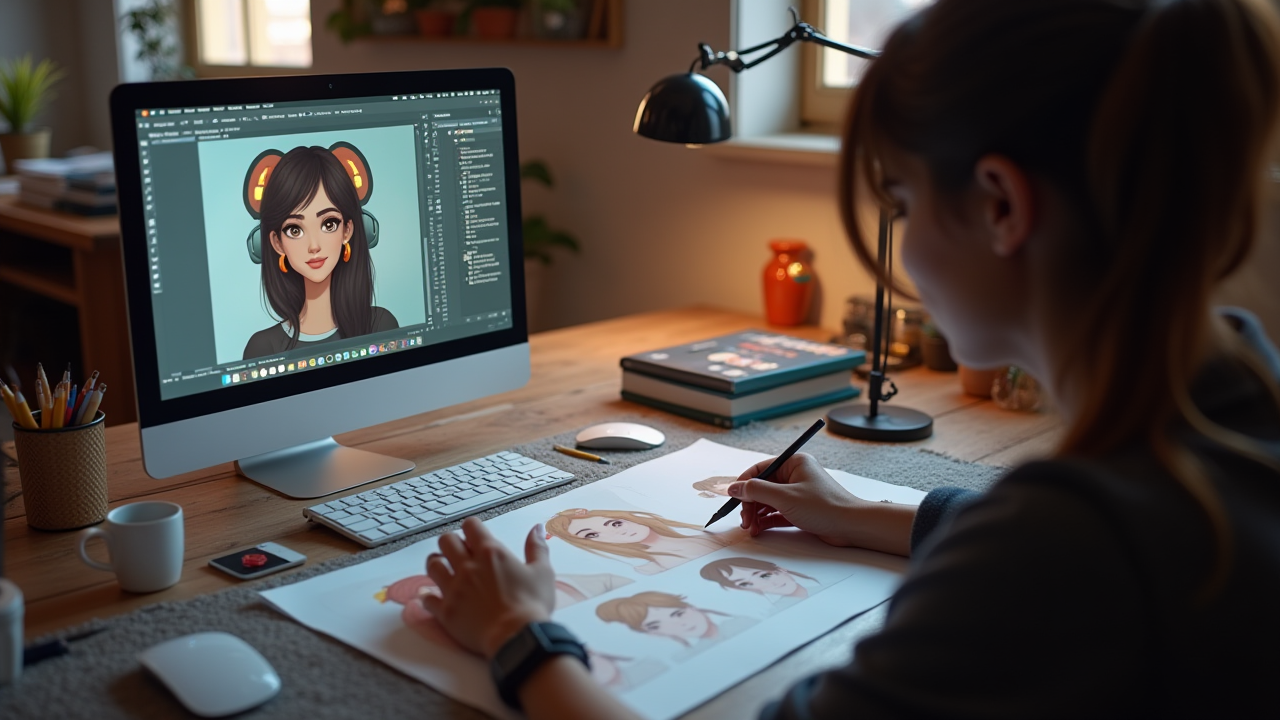
Studio Queues Team · Last updated June 24, 2026
Learn realistic pricing ranges and workflow for vtuber commissions including design only, rig-ready deliverables, full package, and stream overlays.
You got asked to do vtuber work. Maybe a friend who's about to debut. Maybe a stranger who saw your character art and reached out. You said you could probably do it, started quoting it the way you'd quote a regular character commission, and somewhere around the third email you realized this is a different job.
Expression sheets. Layered PSDs. Rig handoff specs you've never heard of. A client who's going to monetize streams with this design and wants to know what the license actually covers. A payment structure that has to match the delivery phases because the rigger only starts once the design is approved.
This guide is the version of all of that you can actually use. The three project types most artists are asked to take, realistic price ranges, the milestone structure that holds up, what "design only" actually means in deliverable terms, the expression set, and the licensing questions that should be answered at intake and not after the work ships.
The label is loose. It covers at least three different jobs that look similar to clients but are very different on your end.
Design only. You deliver the character design as an illustration. The client takes it to a separate rigger for animation. You're doing concept and key art. This is closest to a normal character commission, with one important catch: the file the rigger needs is not the file you'd deliver to a regular client. More on that below.
Design plus rig-ready deliverable. You deliver the character design as a layered file structured for rigging. Every body part, hair strand, expression element on its own labeled layer. This is significantly more work than design only because the layer architecture has to be planned from the start. The rigger then takes this file and does the rig in Live2D Cubism or a 3D equivalent.
Full package. You deliver design plus rig. Either you rig it yourself (which requires Live2D Cubism or a 3D tool you know) or you subcontract the rigging and manage the whole project as a package the client books from one person. This is the highest price point and the most complex to structure.
There's also a fourth category, rigging only, where the client supplies the artwork and pays you just for the rig. Skip this guide if that's what you're doing, the workflow is different enough that it deserves its own treatment.
The 2D versus 3D split matters too. Most vtuber commissions are 2D because Live2D's pipeline is more accessible. 3D vtuber work runs through VRoid, Blender, and the VRM file format, with a smaller and more specialized artist pool. The pricing and workflow below assume 2D unless flagged otherwise.
Vtuber commission pricing varies more than almost any other commission category. Skill level, complexity, rig fidelity, and turnaround all push the numbers around significantly. The ranges below are indicative based on what's commonly discussed in vtuber artist communities, and they're a starting point for your own pricing rather than a fixed schedule.
Design only, with the rig-ready PSD: roughly $400 to $2,500. The lower end is a beginner artist doing a simpler chibi or anime style without significant outfit detail. The upper end is an experienced artist with a recognizable style, complex outfit, props, and accessories. Most working artists who take this kind of work regularly land somewhere in the $700 to $1,800 range.
Rigging only, supplied artwork: roughly $500 to $4,000+. Low end is a basic rig with eye blink, mouth sync, and head tracking. High end is a complex rig with physics simulation on hair and accessories, multiple expression toggles, body tracking, and stream-ready integrations.
Full package design plus rig: roughly $1,500 to $8,000+. This combines both above. Top-tier vtuber artists with strong portfolios price full packages well into five figures and book out months in advance.
For comparison points, general commission pricing gives a baseline for how to think about hourly rate and complexity. Vtuber work sits at the higher end of complexity for the same hours because the deliverable is technical, not just a finished piece.
Add-ons are a real revenue source on top of these. Extra outfits commonly run 30 to 50 percent of the base design price. Additional expressions beyond the standard set are usually $20 to $80 each. Props or weapons priced separately. Stream overlays bundled or à la carte.
Most vtuber clients eventually need a full stream package, not just the model. There's significant additional revenue here for artists who can offer it, and it's a natural extension of the design work since you're already building the visual identity.
The common pieces:
Channel banner and avatar. The static identity assets for Twitch and YouTube. Usually $100 to $400 depending on complexity. Often bundled with the design.
Stream overlays. The frames, webcam borders, and chat box treatments that wrap the stream. Animated overlays cost more than static. Typical range $200 to $800 for a full set.
Alerts. Follow, sub, donation, and raid alerts. Static images plus optional animation. Range $100 to $500 for a full set.
Be right back and starting soon screens. Full-screen scenes for stream transitions. $50 to $200 each.
Panels. The "about me" panels under the stream. Usually $50 to $200 for a full set.
Emotes and badges. Sub emotes for Twitch and Discord. Priced per emote, typically $30 to $150 each. A typical sub emote tier set is six to twelve emotes.
Bundling these with the design commission as a "full launch package" is common and lets you price the bundle slightly under the sum of the parts as an incentive. It also locks more of the visual identity work to you, which protects your credit on the project.
If you don't do all of these yourself, you can refer them out to other artists you trust and take a small referral cut, or just include the recommendation as part of your delivery and skip the cut. Either is fine, depending on your relationship with the client.
Vtuber commissions are the textbook case for milestone payments. The work delivers in phases, the client can sign off at each phase, and the payment matches the work that's already been done. The structure that holds up across most projects:
Milestone 1, design approval. The character concept and key art. Client signs off that the design is what they wanted. Payment release: 30 to 40 percent.
Milestone 2, expression set. The full set of expressions delivered. Standard set is usually around eight (more on which ones below). Client signs off that the expressions cover what they need for streaming. Payment release: 20 to 30 percent.
Milestone 3 (if rigging is included), rig completion. The rig in the client's chosen tool, tested with their tracking setup. Payment release: 30 to 40 percent.
Milestone 4, final delivery and handover. All files delivered, including the source PSD or equivalent, layer documentation, and any usage notes. Payment release: remainder, typically 10 to 20 percent.
If you're doing design only, milestones 3 and 4 collapse. If you're doing full package, all four apply.
The reason this structure works is that the client's risk is bounded at each phase. If they hate the initial design, they've paid 30 percent and they can walk. They lose the deposit, you lose the rest of the project, but neither side has invested more than they can absorb. Same logic at each subsequent gate.
For your side, the structure means you're never doing significant work without a payment having released for the previous phase. If the client disappears after expression set, you've been paid for design and expressions, and you stop work on the rig. The job is fully accounted for at every stop.
Running this manually with invoices between phases is painful. You're cutting Stripe links by hand, tracking who's paid what, chasing signoffs over Discord, hoping you don't miss a milestone. Studio Queues is built for exactly this kind of staged work. You set the milestone splits and signoff requirements at the intake, the platform handles the payment release at each phase, and the records are all tied to the commission. Vtuber commissions are the textbook case for the structure, and rolling it yourself with a stack of Stripe invoices and a spreadsheet is hours of work per project that the platform handles by default.
The most common scope failure on vtuber design jobs is the artist delivering a flat illustration instead of a rig-ready file. The client takes it to a rigger, the rigger says "this isn't usable, I need it in layers," and the artist ends up doing the layering work after the fact, unpaid, because the original quote didn't specify it.
A rig-ready 2D file for Live2D needs:
Common formats are PSD (Photoshop) and CSP (Clip Studio Paint). PSD is the most universal because every rigger can open it. CSP is fine if you're rigging it yourself or if you've confirmed the rigger uses Clip Studio.
The layering work is real labor. Building a rig-ready file from scratch typically takes 20 to 40 percent more time than building a flat illustration of the same complexity. Price it accordingly, or price design-only-flat as a separate cheaper option and document clearly that flat designs are not rig-ready.
If the client has already picked a rigger, get the rigger's specs before you start the design. This is the single biggest avoidable problem on design-only vtuber jobs.
Different riggers have different layer requirements. Some want hair physics broken out into individual strands. Some want the mouth as a single deformable element, others want six discrete mouth shapes. Some want the face on a separate canvas from the body for easier rigging of the head turn. None of this is standardized.
The fix is a fifteen-minute conversation with the rigger before design starts. Ask for their layer spec document if they have one, or a checklist of what they need. Most established riggers will send it over without you having to push. If they don't have one written down, ask them directly: hair physics, mouth shapes, face/body separation, expression component structure.
Document what they ask for. Build the design to that spec. When you deliver, the rigger opens the file and gets to work instead of sending it back with a list of corrections.
If the client hasn't picked a rigger yet, recommend they pick one before design starts so you can coordinate. If they push back ("just deliver the design and we'll find a rigger later") and you've never worked with that situation before, charge for the layer architecture decisions you're making blind. You're going to guess at requirements and you might guess wrong.
When the design is delivered, the handoff should include:
Avoid Discord DMs for the file transfer. Use a service that holds the file with a timestamp and a link the rigger can pull from at their convenience. Discord file expiration has eaten more vtuber project handoffs than any other cause.
If the rigger comes back with required modifications to the design (which happens on maybe a third of jobs), quote those modifications as a separate small fee. The client booked design, you delivered design. Rigger-requested changes are technically a new scope item. Most clients accept this without pushback if you frame it as a normal part of the process.
Most vtuber rigs use a small set of base expressions that the model can interpolate between. Eight is the common standard, but it varies. The typical list:
Some clients want more. Common add-ons: tongue out (for the "blep"), heart eyes, sparkle eyes, X-eyes (knocked out), tears, sweat drop.
Each expression is more than just a different face. For the standard set, you're delivering the components that change between expressions, not redrawing the whole character. New eye shapes, new mouth shapes, new eyebrow positions, sometimes new cheek elements like blush or sweat. The rigger blends these into the base via the rig parameters.
Price the standard set as included. Price extras à la carte, typically $30 to $80 each depending on complexity. Document this in your intake so the client knows what they're getting and what costs more.
This is where most vtuber commissions create problems later. The client is going to use this design to make money. Streaming with it, possibly merch, possibly sponsorships. The license you grant determines what they can do.
Questions to answer before the design phase starts:
Is the design exclusive to the client? Most vtuber clients expect exclusivity for streaming use. If you're including exclusivity, the price reflects it. If not, document that the design can be sold to others.
Can the client modify the design after delivery? Usually yes for minor edits, sometimes no for substantial changes. If you allow it, decide whether modifications still credit you.
Can the client use the design on merch? Most vtuber clients eventually want merch. Some artists include merch rights, most charge a separate license fee for it. Common structures: a flat merch license fee, a percentage royalty, or merch rights included up to a revenue threshold.
Can the client use the design for sponsored content? Brand partnerships where the vtuber endorses products. Some artists are fine with this, some require separate licensing for major sponsorships. Define your line before it comes up.
Credit requirements. What credit does the client owe you? Common standard: artist credit in the channel description, plus a credit on the model debut announcement. Some artists require credit on every clip or merch item, which gets awkward to enforce.
What happens if the client transfers ownership of the model? Vtuber identities sometimes get sold or transferred. Decide whether your license transfers with the model or whether the new owner needs to renegotiate.
Get all of this on the intake form. The point of locking these answers at booking is that you have a written record from before the work started, with the client's agreement timestamped. Studio Queues' intake bakes the click-to-accept TOS into the submit, which is what turns "the client agreed to these terms" into a record that holds up in a dispute. Whatever tool you use, the principle is the same: licensing answered in writing at intake, not in a Discord thread three months later.
The points where vtuber commissions most often go sideways:
Mid-design redirect. Client approves the initial concept, then halfway through the colored design says "actually can we change the hair entirely." Your TOS should specify revisions allowed at the sketch stage but not after color is locked. New direction after that point is a quote for additional work.
Expression set expansion. Client signs off on the standard set, then asks for "just a couple more" expressions after delivery. Quote them as add-ons. Each one is real work.
Rig request after design delivery. Client booked design only, then comes back asking if you can rig it too. Quote it as a separate project. Don't fold rigging into a design-only quote retroactively.
Outfit variants. Standard practice on vtuber models is one outfit. Clients sometimes assume "the design" means "all the looks they might want." Be explicit in the intake that base price is one outfit, additional outfits are separate.
Streaming start date pressure. Client mentions they're debuting on a specific date. Suddenly their deadline pressure becomes your problem. Set turnaround time at the intake based on your queue, not based on the client's preferred launch. If they want rush, they pay rush.
When the project closes, the final handover usually includes:
Pack it all into a single archive, send via your platform's delivery system or a service that holds the file with a timestamp. Studio Queues handles final delivery inside the commission record itself, so the handover is timestamped against the project and lives with the rest of the agreement. Discord DMs are the wrong channel for any of this. Attachments expire, threads get archived, and "I sent you the file in October" is not a delivery record.
Vtuber commissions are good work if you set them up correctly. The pay is higher than average, the clients tend to be more committed than impulse character commission buyers, and the milestone structure means you're protected at every stage.
They go wrong when artists treat them like normal character commissions and find out at delivery that the deliverable doesn't match what the rigger needs, or that the client expected merch rights, or that "just a few extra expressions" wasn't in the quote. Almost every problem on a vtuber commission is upstream of the actual art work and is solved at the intake stage.
The structure: clear project type at the intake, milestone payments matched to the delivery phases, licensing answered in writing before design starts, expression set scoped at booking, and a final handover that closes the file cleanly. Studio Queues is built around all of this by default. The intake captures the scope, the milestones split and release as you deliver, the TOS click is recorded with a timestamp, and the final handover lives with the commission record. If you'd rather build it yourself with a stack of Stripe links, a Google Form, a Discord thread for messaging, and an email folder for the records, that path works too. It's just a lot more setup and a lot more places for the paper trail to break.
Either way: charge accordingly, deliver in phases, document the license, and treat the rig-ready file as a distinct deliverable from a regular illustration. The rest takes care of itself.