Studio Queues Team · Last updated July 17, 2026
Fursona commission cost by format in 2026: icons, badges, refsheets, YCH, full-body illustrations. What buyers should specify and how anthro pricing works.
The furry commission market has its own vocabulary, its own dominant platforms, and its own pricing conventions that differ meaningfully from general character illustration. Buyers moving between the two markets often misprice what they are looking at because a "badge" and a "half-body illustration" are recognizable format names in the anthro space with specific expectations that a general commissioner would not know to ask for. This guide covers realistic fursona commission cost ranges in 2026 across the common formats, what buyers should expect to specify, and how the workflow typically runs from intake to delivery. It is written to be useful to buyers commissioning their first fursona piece and to artists sizing up the market.
The anthro commission market is anchored across a handful of platforms and social spaces: FurAffinity has been the community hub for two decades and remains where most artists post galleries and take commission notes; Weasyl, Inkbunny, and SoFurry serve as secondary galleries; Twitter and Bluesky handle real-time announcements, YCH auctions, and open-slot posts; Telegram and Discord handle client communication and delivery for many artists. Payment processing usually runs through PayPal, Stripe, or Ko-fi, with a small number of artists offering crypto for higher-value work.
Pricing conventions in the anthro market skew slightly lower per format than the general character illustration market at the low end and comparable at the high end. This is not because the work is less skilled; it is because the community developed under a heavy YCH-style, batch-sale culture that keeps entry-level pricing accessible. Top-tier anthro artists command prices comparable to top-tier general illustrators, and their queues fill just as fast.
Realistic fursona commission cost ranges for independent artists in North America and Europe in 2026. Prices assume personal-use licensing; commercial use is priced separately and typically 2x to 3x the personal-use rate.
Fursona commission cost scales with the same inputs as any illustration commission: rendering level, complexity of the character design, character count, and background detail. A character with elaborate markings, complex clothing, wings, multiple tails, or intricate accessories takes longer than a simple canid or feline in a plain outfit. Artists price for the labor, not the format name.
Three structural differences shape anthro pricing versus general character illustration.
Character design complexity is often higher. A fursona typically has species-specific anatomy (muzzle, ears, tail, digitigrade or plantigrade legs, paws or hands), markings or fur patterns that need to be reproduced accurately, and often accessories that carry over across every piece. Getting these right takes reference research the artist does not need for a stock human character. Fursonas with complex markings (patchwork, bicolor patterns, multiple accent colors, tribal markings, or freckles) cost more consistently than solid-color characters.
YCH culture keeps entry-level pricing accessible. The community developed heavy conventions around pre-drawn bases sold as slots, which means a lot of clients enter the market at $30 to $80 price points for their first pieces. This filters upward: buyers who start with cheap YCHs graduate to $200 half-bodies and $600 full-bodies later. Artists supporting this pipeline often maintain a mix of low-priced YCH work and higher-priced custom commissions.
Convention badges are a distinct format. Named after physical convention badges worn at furry cons like Anthrocon, Midwest FurFest, and Furry Weekend Atlanta, the "badge" format persists as a digital pricing tier even for buyers who will never print one. The format is typically a bust or half-body with a name banner, sized to fit a real physical badge (roughly 3 by 4 inches at print resolution). This is a specific and priceable format the buyer should specify explicitly.
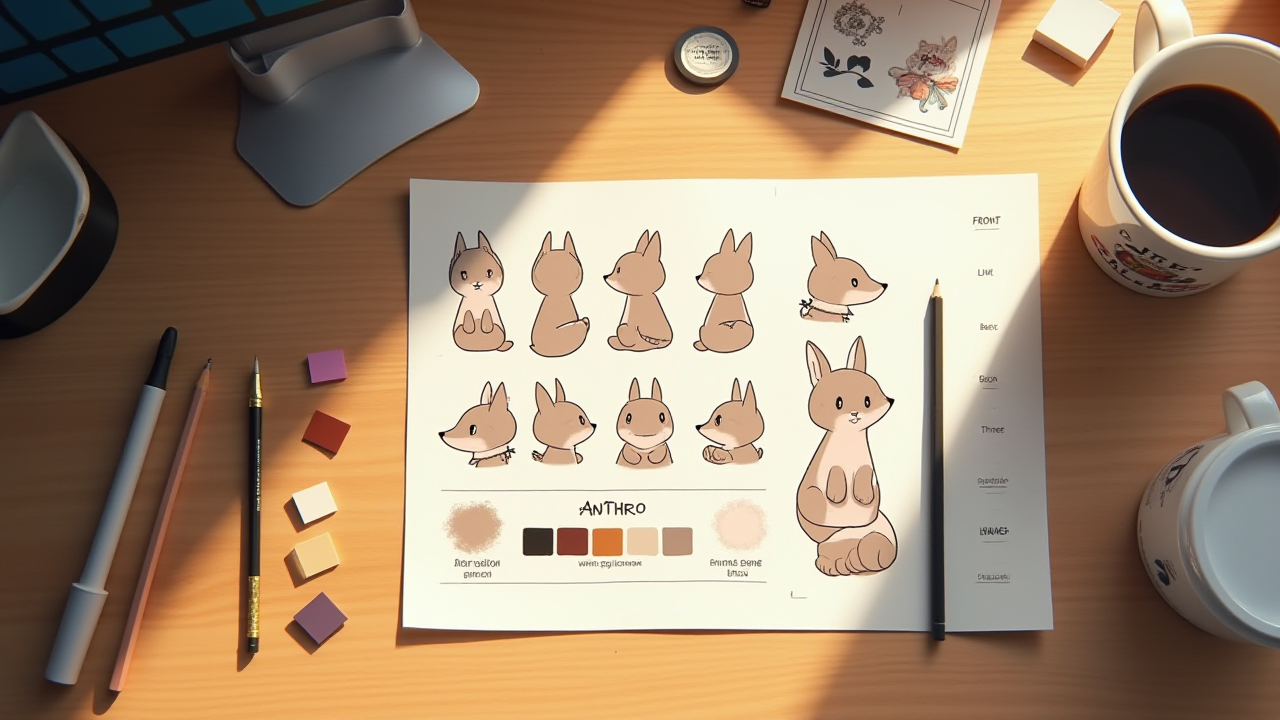
Reference sheets are especially important in the anthro commission market because most fursonas get commissioned dozens of times over their lifespan, and each downstream artist works from the refsheet. A thorough refsheet pays for itself many times over across the character's lifetime of commissions.
Standard anthro refsheet elements typically include front and back turnaround views, headshot with expressions, close-ups of markings and unusual details (paw pads, tail tip, ear inside color, muzzle stripes), color palette callouts with hex codes, and character height and species notes. For fursuits specifically, refsheets add material and construction notes (mask style, tail construction preferences, hand paw style), color-matched fabric swatches when possible, and multiple angles of every unusual anatomical feature. For more detail on what to specify at intake and the price bands to expect, the general character refsheet guide covers most of the same territory: see the character reference sheet guide covers what to specify on a refsheet.
Refsheet copyright follows the same default as any commissioned illustration. Per the U.S. Copyright Office guidance for visual and graphic artists, the artist retains copyright to the illustration itself; downstream commissioners work from the refsheet as reference material, but that reference use is a normal community convention rather than a formal license transfer. Buyers commissioning a refsheet with intent to use it commercially (character branding, published work, merchandise) should discuss commercial-use licensing with the artist at intake, not assume it is included.
YCH (Your Character Here) commissions are a bigger portion of the anthro market than of the general character illustration market. Popular anthro YCH bases sell across multiple slots or run as auctions with lively bidding. Realistic YCH pricing:
YCH bases save artists design time and buyers save cost, but buyers should understand what they are and are not buying. The pose, composition, and outfit are the artist's design; the character-specific elements (species, markings, colors, accessories) are what the buyer customizes. YCH is not a discount custom commission; it is a different product.
A common question in the anthro market is who owns the fursona design itself, distinct from any specific illustration of it. The short version: if the buyer commissioned the original character design from an artist, the design is a work created by that artist and copyright rules apply the same as they do for any commissioned illustration. Buyers commissioning original character designs should discuss usage rights at intake, including whether commercial use of the character design (branding, merchandise, licensing to other creators) is included.
Most casual fursona designs are commissioned with an implicit understanding that the buyer can use them as reference material for future commissions and can display the character in personal contexts. Commercial use, monetized streaming under the fursona's identity, merchandise, or licensing to other creators is a separate conversation. Artists commissioning refsheets for VTuber or streaming use should confirm streaming-tier licensing rather than default personal-use. For more resources on commission types, licensing, and workflow, browse more Studio Queues resources on commission types and workflow.
Fursona commission cost in 2026 ranges roughly $30 for a simple icon to $700+ for a fully rendered full-body illustration, with refsheets sitting anywhere from $150 to $900 depending on scope. YCH slots and badges represent large portions of the market at accessible entry-level pricing. Refsheets are worth investing in early because the character will be commissioned many times over its lifespan and the sheet pays off across every future piece.
The core pricing framework is the same as any illustration commission: base hourly rate, complexity multiplier, usage license, and overhead reserve. The specific format names in the anthro market (badge, refsheet, YCH, chibi) map onto that framework rather than replacing it. Buyers who understand this get faster quotes and more accurate expectations; artists who understand it can price fairly without either undercharging or losing the entry-level tier that keeps clients coming back.
If you want a workflow platform that supports structured intake with fields for species, markings, character design references, milestone payments on higher-value work like refsheets and full-body commissions, and clear licensing tiers, you can lock in 0% platform fees while founding artist spots are still open. The founding artist program keeps 0% platform fees active for as long as your premium subscription stays active, and only the first 500 spots are available. Payment processing fees (Stripe) still apply the same way they would on any platform.